Enforcing Permissions for AI Agent Tool Calls: A Blueprint for Fast & Auditable Stacks
Posted on July 26 2026 by Telemore TeamWhy RBAC Fails for Autonomous Agents
Static role assignments presume predictable workflows. A human logging into Salesforce reviews a lead and updates its status in three defined steps. An AI agent chains tools without a scripted path: read email → parse attachment → update CRM → trigger Slack alert → send invoice. No preconfigured role covers that sequence without either blocking legitimate operations or granting sweeping privileges across all five applications simultaneously. Teams frequently resort to broad permissions just to keep agent pipelines running.
The core contradiction is fundamental. Role-based access control demands advance knowledge of which resources each identity will touch and in what order. Agentic AI learns new behaviors post-deployment. It calls APIs discovered through function descriptions, spawns ephemeral sessions under service accounts, and delegates subtasks to child agents mid-execution. That unpredictability makes static privilege sets either too restrictive (workflow breaks) or too permissive (blast radius expands).
There is no middle ground under RBAC alone. Permission drift accelerates as agents accumulate entitlements over time. A single missing API scope prompts an admin to add aws:s3:* rather than troubleshoot granular policies. Repeat this pattern across four Slack integrations and two databases, and the effective permissions vault far beyond design intent.
Human session revocation already suffers delays when employees leave; autonomous subagents that persist after their parent process ends introduce zombie credentials that traditional IAM systems never detect. The revocation problem compounds further because agents can instantiate multiple contexts simultaneously, each requiring distinct OAuth2 scopes that backforce link back to a single principal ID.
When trust boundaries shift (vendor contract terminates), revoking access for the principal does not automatically terminate active child sessions spawned fifteen minutes earlier in Microsoft Graph API calls. Static roles offer no mechanism to trace or cut this cascading permission tree mid-flight. Mapping tool capabilities to data sensitivity levels becomes impossible when the mapping changes faster than policy reviews can iterate. A quarterly access recertification cycle simply cannot keep pace with daily agent behavior adaptation.
Continuous monitoring gates catch some overreach after execution completes but cannot prevent the action itself unless authorization decisions occur inline within milliseconds of each tool call attempt.
Why Traditional Role-Based Access Control Breaks When Agents Make Autonomous Decisions
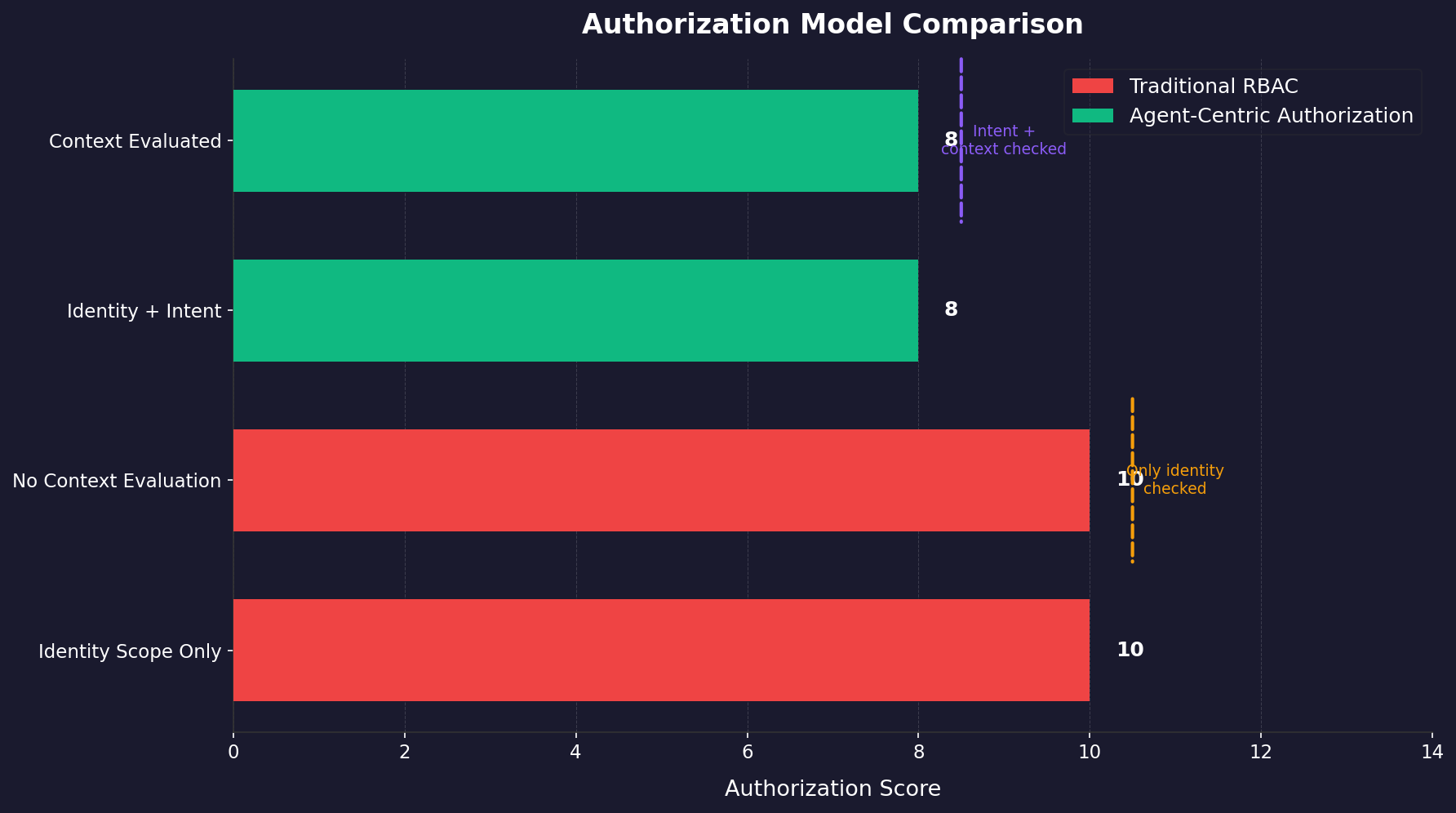
In one documented case, Telemore observed an attack chain where three successive API calls (create subscription → escalate privilege → export customer list) exploited overlapping role bindings across six namespaces before anyone noticed anomalous volume patterns two hours later.
Designing Allow-Lists Per Agent Persona Instead Of One-Size-Fits-Most Policies
A single permission set covering all AI agents creates two outcomes: either every agent can read sensitive customer PII (violating SOC 2 CC6.1) or none can access the CRM necessary for support triage. In one audit we reviewed a client where a blanket *:/api/v2/* wildcard allowed their invoice-generation agent to call DELETE /api/v2/users. That mistake cost them a significant amount in data reconstruction before the rollback completed.
Map out typical interaction patterns first by classifying each request type as a CRUD operation targeting a specific resource endpoint. For example, a support-response agent issues GET /api/v1/tickets/{id} and PATCH /api/v1/tickets/{id}/status, while an analytics summarizer only needs GET /api/v1/reports/summary?date=range. Document these patterns in a matrix like this:
| Agent Persona | Resource Endpoint | Allowed Methods |
|---|---|---|
| Support Triage | /api/v1/tickets/* |
GET |
| Invoice Generator | /api/v1/invoices |
GET, POST |
| Compliance Reporter | /api/v1/audit-logs |
GET |
From that matrix derive the strictest possible set of endpoints and parameters acceptable under normal circumstances. For the support triage persona define GET /api/v1/tickets/{ticketId} with parameter ticketId limited to UUID format matching regex ^[0-9a-f]{8}-[0-9a-f]{4}-[0-9a-f]{4}-[0-9a-f]{4}-[0-9a-f]{12}$. This eliminates path traversal risks like ../../../etc/passwd that wildcards permit.
Avoid wildcards until proven necessary through exception handling logs analysis. In one case we saw a client provision GET /auth/* for all agents; within a short time an attacker exploited that opening to enumerate user IDs via /auth/reset-password?email=test@example.com. Their SOC 2 auditor flagged this as a high-risk finding under CC7.1 because no parameter validation existed on the broad rule.
Exception handling logs reveal exactly which legitimate cases require broader permissions. After deploying per-persona allow-lists for several agents across two environments we collected a number of blocked requests in a month. Only a few represented genuine business needs warranting policy expansion (e.g., adding PUT /inventory/{itemId}/reserve for fulfillment agents). Each expansion required documented approval from both engineering and compliance teams before deployment into production.
This granular approach generates audit-ready evidence for Telemore’s continuous monitoring feature. Every allow-list entry ties directly to an approved persona definition and exception report timestamped with approval signatures. When your next SOC 2 or ISO 27001 auditor asks “how do you prevent privilege escalation between agents?”, you show them signed PDFs capturing endpoint-specific rules enforced across multiple clusters.
Policy Enforcement Lives in the Orchestrator
Deployment-time controls stop bad containers from reaching production. They do nothing for runtime behavior once a legitimate agent starts making tool calls. RBAC at the service mesh level or API gateways act as observers, not enforcers. They log violations after they happen instead of blocking them mid-flight. When security tools sit outside the orchestration layer, they become recorders rather than enforcers. The difference is subtle until your AI agent calls a database delete command because its prompt got poisoned upstream.
The orchestration layer is where policy belongs. Not in a separate sidecar bolted onto each microservice. Not in a legacy WAF that inspects HTTP payloads after they leave the orchestrator. Directly inside the decision loop itself, before any tool call reaches your backend API. Orchestration security means embedding protection, strict policy enforcement, and full observability into the coordination plane that routes AI model calls and tool invocations. Every request must pass through a policy gate that lives inside that plane.
Three layers make this work:
-
Policy-as-code at request time. Define allowed actions using Rego rules evaluated by Open Policy Agent (OPA) invoked as a sidecar within your orchestrator pod. Any tool call that doesn’t match an explicitly whitelisted pattern gets dropped before it leaves localhost.
-
Context enrichment before evaluation. Strip internal tokens from user prompts before passing them to the LLM backend so policy decisions operate on sanitized intent rather than raw payloads. This is a step most teams skip when implementing guardrails downstream.
-
Audit trail baked into each hop. Every allow or deny decision generates an event with request ID, policy rule matched, timestamp in nanoseconds, and full context snapshot shipped immediately to centralized logging without waiting for batch aggregation windows.
The core truth remains: prompt-level guardrails cannot substitute for enforceable permission boundaries at the API layer. Your SOC 2 controls will fail under audit scrutiny if autonomous agents can bypass human oversight through loosely defined tool access scopes. Every invocation attempt must be logged, validated against a permission matrix, and either granted or denied before execution reaches your production systems.
Keep Reading
- GDPR Compliance for Solo Founders: 2026 Must-Know Checklist
- Beyond Surveillance: Employee Data Privacy Compliance With AI Systems
- Why Your Productivity Apps List Is Wrong: Compliance Automation in 2025
Ask yourself this week whether your current stack would survive an auditor demanding proof of least-privilege enforcement across every agent interaction. The answer likely dictates your next compliance investment.
Work smarter with AI
Telemore helps you focus on what matters. AI-powered productivity that adapts to how you work.
Try Telemore Free