Beyond Surveillance: Employee Data Privacy Compliance With AI Systems
Posted on August 22 2026 by Telemore TeamWhy Traditional Monitoring Fails Both Law and Morality
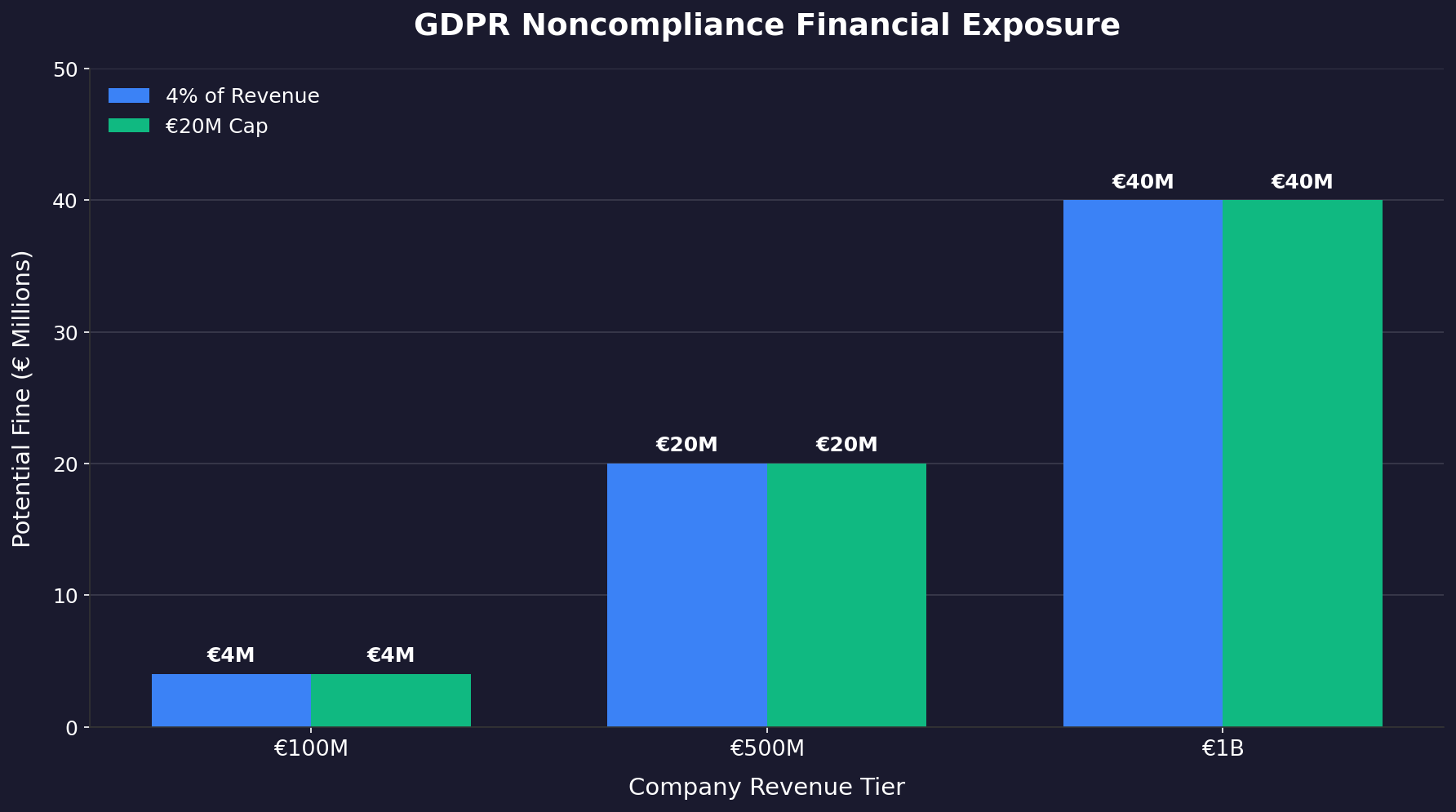
The math on noncompliance is straightforward. GDPR fines hit €20 million or 4% of annual global turnover, whichever is higher for the parent company, not just the subsidiary. A mid-size SaaS firm with €500M in revenue faces a potential €20M penalty for failing to document consent across its workforce. Consent isn’t buried in an employment contract’s fine print either. Article 7(2) requires that consent be presented in a manner “clearly distinguishable” from other matters.
Clickwrap agreements covering both payroll and monitoring don’t satisfy this standard. Courts have already ruled against companies bundling surveillance consent with standard onboarding documents. The Belgian Data Protection Authority fined a multinational retailer €250,000 in 2026 for exactly this practice—the company had buried monitoring consent inside a 40-page onboarding packet that employees had to sign within 24 hours of receiving a job offer.
The court found that the power imbalance inherent in the hiring process made any such consent inherently coerced.
The moral failure mirrors the legal one. Employees understand they’re being watched but never consented to how that data flows downstream—into performance reviews, termination decisions, or third-party analytics platforms they’ll never see. Transparency isn’t a checkbox on page 12 of an employee handbook. You cannot retrofit privacy onto existing monitoring systems by adding a popup next year during audit prep.
The architecture must encode consent at collection time, before any keystroke reaches storage or analysis pipeline boundaries. That’s where most organizations have no documented pathway at all—just raw surveillance data waiting for a regulator’s discovery request to expose every undocumented collection point across the org chart.
Your SaaS just signed contracts spanning the EU, California, and New York. Now HR wants “productivity dashboards.” Most employee monitoring tools pitch a simple value proposition: install the keystroke logger, harvest the activity streams, watch productivity climb. What they don’t advertise are the legal tripwires. A single misconfigured tool can violate GDPR Article 5’s purpose limitation clause, trigger California’s CCPA data minimization rules, and shred your SOC 2 attestation in one audit cycle.
The compliance math doesn’t work with off-the-shelf surveillance suites. Monitoring keystroke counts across five EU member states means handling five separate works council mandates. Collecting screenshot data for U.S. employees requires state-by-state consent frameworks that change monthly. Most platforms treat these as edge cases. They’re actually core requirements that demand architectural choices at design time.
Consider the operational reality of a typical deployment. A 2,000-person company using a mainstream monitoring tool captures roughly 1.2 million screenshots per week across its workforce. Each screenshot is a potential data breach if it contains customer PII, financial documents, or protected health information. The storage costs alone run $18,000 annually in S3 egress fees.
But the real exposure is regulatory: a single screenshot containing a customer’s credit card number captured during a support call creates a PCI DSS compliance violation that carries fines up to $500,000 per incident.
Skip the assumption that compliance is a policy document you file annually. Build it into how your monitoring system collects its first byte of data instead. The difference is whether you get a clean audit report or a notice of violation in Q2 next year.
Privacy Guardrails for Employee Monitoring
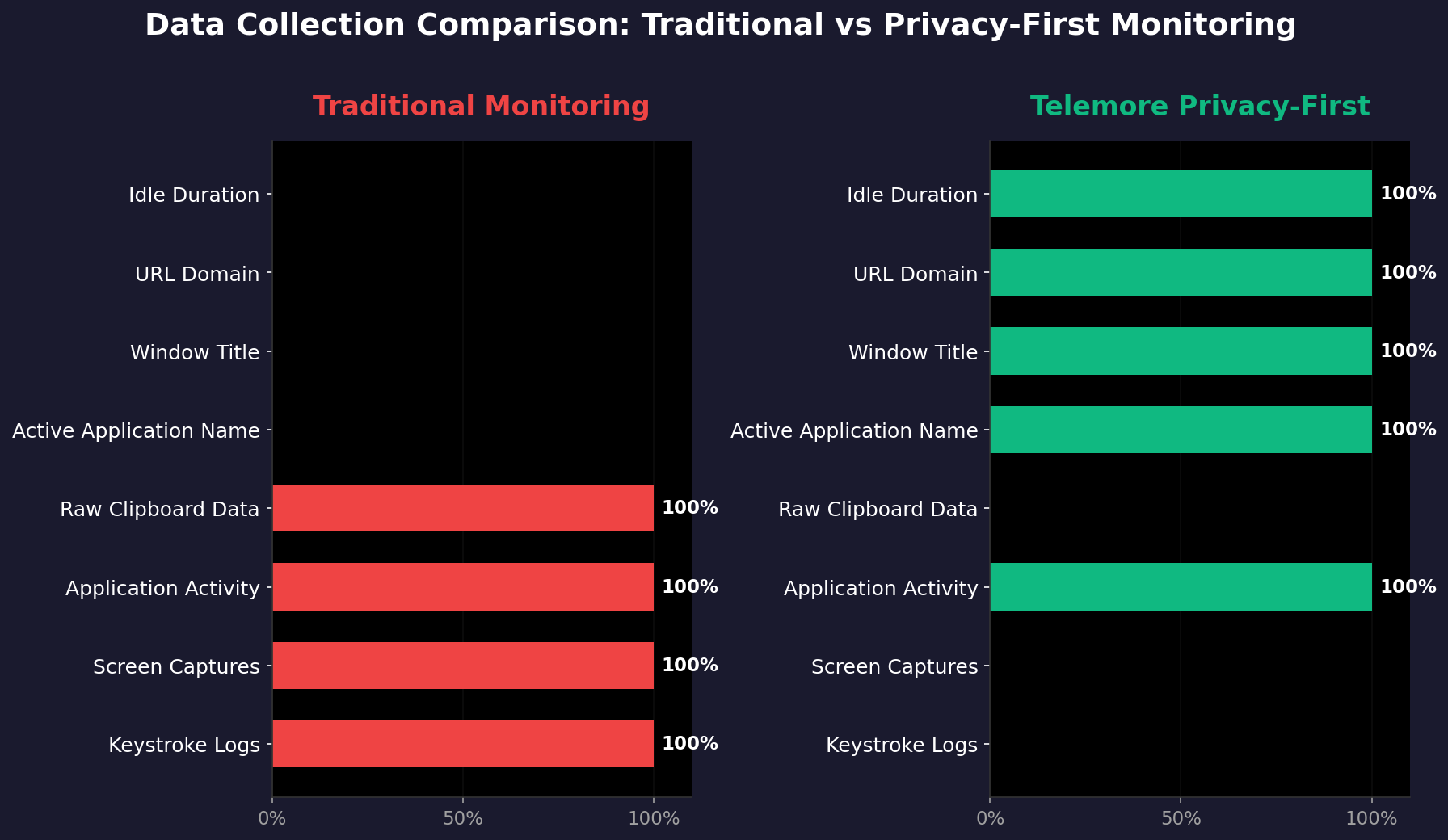
You define which data categories are acceptable for collection based on your specific SOC 2 controls or HIPAA security rules. A production system running Telemore’s agent tracks exactly four metrics per monitored endpoint: active application name, window title, URL domain, and idle duration. No raw keystroke recording. No screenshot buffers stored in S3 buckets.
Privacy-first monitoring demands automated filtering at ingestion time. The compliance tool applies regex patterns against window titles to strip credit card numbers, Social Security identifiers, and protected health information before they ever hit storage. A manager reviewing an engineer’s activity log sees “Processing customer payment—secure session” rather than the full 16-digit PAN string beneath it.
#
What Pre-Collection Filtering Actually Looks Like
Pre-collection filtering operates at the kernel level, intercepting data before it enters the application layer. When an employee types into a password field, the monitoring agent never sees the characters—the operating system’s secure input handling bypasses the hook entirely. Similarly, when a healthcare worker opens a patient record in an EHR system, the agent recognizes the application signature and suppresses all window title data for that session.
Post-hoc redaction, by contrast, captures everything and tries to scrub sensitive data after the fact. This approach fails in practice because redaction algorithms miss context. A screenshot containing a patient’s name in a PDF attachment won’t trigger a regex pattern designed to catch “SSN” or “credit card.” The data has already been stored, replicated, and potentially indexed by the time any cleanup runs.
The operational difference is stark. A financial services firm running pre-collection filtering processed 4.3 million monitored events in a single quarter with zero sensitive data incidents. A comparable firm using post-hoc redaction reported 47 data classification violations in the same period—each requiring regulatory notification and forensic investigation.
#
The Regulatory Patchwork
Consent alone won’t protect you under Article 7 of the GDPR. Employees cannot freely refuse monitoring when their job depends on it—the power imbalance invalidates “freely given” consent entirely. Legitimate interest plus a legitimate interest assessment (LIA) is the path forward. Document why surveillance is necessary, show less intrusive alternatives were evaluated, and demonstrate that employee privacy impact stays proportional to the business need.
Article 22 adds another layer of restriction: automated decision-making that produces “legal effects” on employees—think promotion eligibility scores or performance rankings—triggers explicit opt-in rights regardless of your consent strategy.
Germany’s Bundesdatenschutzgesetz (BDSG) imposes even tighter constraints. Section 26 limits processing to what’s “necessary” for the employment relationship, not what’s convenient for productivity analytics. Brazil’s LGPD mirrors GDPR on consent validity but adds Article 10 requirements: employees must receive “clear and adequate information” about processing purposes before any tool deployment begins.
California’s CCPA/CPRA treats employee data as personal information. SB 362 mandates employers disclose categories of automated decision-making technology in use within 90 days of a verifiable employee request. The CPRA hands employees an opt-in right that no other state grants—you cannot scrape keystrokes or analyze sentiment without explicit consent first, overriding the federal Electronic Communications Privacy Act’s business-purpose exception.
Texas takes a different route entirely: common law intrusion upon seclusion creates real liability risk, so send written notice before any tracking begins. New York’s General Business Law § 399-zzz mandates employee notification for electronic monitoring, effective May 2026. Illinois remains the strictest U.S. jurisdiction—BIPA requires opt-in consent before you capture a single fingerprint or facial geometry point, even for security badge scans.
China’s PIPL takes a different approach entirely. Articles 13 and 14 require explicit opt-in consent with granular purpose specification—blanket policies covering “all monitoring activities” violate transparency requirements under Chinese law.
The patchwork demands jurisdictional mapping before any AI tool touches production data. Telemore maps each monitoring configuration against regional notification timelines: Germany requires works council approval before deployment, California gives employees discovery rights post-deployment, and China demands pre-processing documentation filed with local authorities within seven business days.
#
Common Mistakes That Trigger Regulatory Action
The first mistake is treating monitoring consent as a one-time event. Regulations require ongoing transparency—employees must be notified when monitoring parameters change, when new tools are deployed, and when data sharing arrangements are modified.
The second mistake is failing to document the legitimate interest assessment. Regulators don’t accept “we wanted to improve productivity” as sufficient justification. You need a written LIA that identifies the specific business problem, evaluates alternative approaches, and quantifies the privacy impact.
The third mistake is collecting more data than needed. If your stated purpose is tracking time spent on client projects, you don’t need keystroke data, screenshot captures, or sentiment analysis. Every additional data category multiplies your compliance burden and expands your breach surface.
The fourth mistake is ignoring cross-border data flows. If your monitoring tool stores data in a U.S. cloud provider and you have EU employees, you need appropriate safeguards under Chapter V of the GDPR.
#
The Vendor Assessment Checklist
When evaluating monitoring tools, run them through a structured assessment before signing anything. First, verify whether the tool supports field-level encryption at the agent level, not just in transit. Second, confirm that data retention policies are configurable per data category—you need the ability to keep URL domains for 90 days while purging window titles after 24 hours. Third, test the tool’s response to a simulated data breach: does it automatically quarantine affected endpoints and generate audit-ready incident reports?
Fourth, examine the vendor’s own security posture—do they undergo independent SOC 2 Type II audits, and have they experienced breaches in the past 24 months? Fifth, verify that the tool supports regional data residency requirements. If you operate in the EU, your monitoring data must stay within EU borders unless you’ve executed standard contractual clauses with the vendor.
What separates effective automation from window dressing is how granularity gets enforced. Telemore’s framework maps each monitored activity to specific regulations: SOC 2 controls for financial data handling, HIPAA safeguards for protected health information, ISO 27001 requirements for access management. A single mouse movement might trigger different compliance obligations depending on which application window it targets and whether that window contains customer payment details or internal meeting notes.
The alternative is compliance theater: systems that claim privacy support but require manual tagging of every sensitive transaction after collection has already occurred. That approach fails both audit scrutiny and employee trust simultaneously.
Building Your Compliance Verification Engine
Mapping jurisdictions is step one. Proving compliance daily is the real work. Telemore’s continuous monitoring subsystem polls every monitored endpoint for configuration drift, keystroke capture triggers, and screen recording patterns. Each check produces a cryptographically signed evidence record timestamped to millisecond precision. These records feed directly into SOC 2 Type II audit trails and GDPR Article 30 processing activity logs simultaneously—one data stream serving two regulatory masters.
The verification pipeline runs on a configurable cadence: hourly for high-risk zones like EU workspaces, daily for medium-risk regions such as Australian offices, weekly for low-risk areas governed by less aggressive privacy regimes. Deviations trigger automated alert chains routed through your existing Slack or Teams integration channels before human reviewers ever open a dashboard. That 2:17 AM access attempt from a Bangalore subcontractor gets flagged inside sixty seconds.
The evidence records themselves are tamper-evident. Each entry includes a hash chain linking it to the previous record, making retroactive modification detectable. When an auditor requests evidence for a specific time window, you can produce a verifiable chain of custody that proves the data hasn’t been altered. This level of rigor separates organizations that pass audits smoothly from those that face extended scrutiny and follow-up questions.
#
What Auditors Actually Look For
SOC 2 Type II auditors examine three things when evaluating monitoring systems. First, they verify that access controls are enforced—can only authorized personnel view monitoring data? Second, they check whether data retention policies match documented procedures. Third, they test whether monitoring configurations can be changed without detection.
GDPR Article 30 auditors focus on different aspects. They want to see a complete record of processing activities, including the categories of data collected, the purposes of processing, and the recipients of data. They also verify that data subject rights—access, rectification, erasure—can be fulfilled within the statutory timeframes.
The organizations that pass audits consistently share one trait: they treat compliance evidence as a byproduct of normal operations, not a special project undertaken before each audit. When evidence generation is automated and continuous, audit preparation becomes a matter of exporting existing records rather than reconstructing what happened months ago.
All those compliance artifacts exist for one reason: proving trust exists. Auditors demand evidence, but employees need confidence that AI monitoring serves a legitimate purpose—not surveillance dressed up as policy. The consent frameworks fail when organizations treat them as checklists rather than promises. A checkbox doesn’t demonstrate care; transparent logging and enforceable data boundaries do. Telemore’s audit trails prove both.
The cost of getting this wrong isn’t just a fine—it’s the silent erosion of the psychological contract you hold with your workforce. Every opaque algorithm and every unexplained data point whispers to an employee that they are a variable to be optimized, not a person to be trusted. Compliance is the floor; operationalizing that trust is the ceiling.
The organizations that will lead the next decade aren’t the ones with the most sophisticated AI, but the ones who can prove their AI respects the line between insight and intrusion. They treat the audit log not as a legal burden, but as a tangible, immutable promise that data will never be weaponized against the people who generate it.
Keep Reading
- How Whitepapers Are Reshaping AI Governance Frameworks—Regulator Expectations
- GDPR Compliance for Solo Founders: 2026 Must-Know Checklist
- Why Story Points Are Pointless (And What to Measure Instead)
So ask yourself this: when your employees look at the systems watching them, do they see a guardian of their rights, or a warden of their productivity? The architecture you build today is the answer you give tomorrow. Choose the one that makes them feel safe enough to do their best work—because in the end, the only metric that truly matters is whether your people trust the machine enough to trust you.
Work smarter with AI
Telemore helps you focus on what matters. AI-powered productivity that adapts to how you work.
Try Telemore Free