Beyond Chatbots: Compliant Multi-Agent Systems with PydanticAI-DeepAgents
Posted on August 26 2026 by Telemore TeamMost companies rushing toward autonomous multi-agent architectures overlook one critical detail. Every conversation log becomes evidence during your next SOC 2 audit interview. Unless designed correctly from day one, those chat histories between AI agents will expose gaps in data retention policies, access controls, and even encryption boundaries you never knew existed. A single unredacted prompt chain can sink an entire certification cycle.
If you’re a solo founder navigating this alone, the GDPR Compliance for Solo Founders: What You Must Know in 2026 checklist is a good place to start understanding the baseline requirements.
PydanticAI-DeepAgents promises to change that calculus. By enforcing structured output schemas at every message boundary, it gives compliance teams something rare: deterministic control over what gets logged and how. No more black-box inference servers dumping raw tokens into your SIEM. This isn’t just a developer convenience feature. It’s an auditor’s nightmare turned manageable.
We’ll walk through exactly how agent architecture choices map to SOC 2 control requirements. The framework for mapping each Agent.run() call to an audit-ready evidence artifact. And the specific schema enforcement patterns that save months of remediation work post-deployment. Your agents will talk fast. Make sure they talk on the record in a format your compliance platform can digest without human intervention. That’s the difference between automation accelerating audits and automation creating them.
1 Why General‑Purpose Agent Frameworks Fall Short Under Audit Pressure
The EU AI Act requires four specific capabilities: notify users they’re interacting with AI, mark AI-generated content machine-readably, disclose how decisions are made, and maintain audit trails. Most agent frameworks treat logging as optional debugging noise. They log model input/output. The hard part surfaces when an auditor asks you to reconstruct an agent’s decision path from six hours ago.
Which context window was active. What tool call failed silently. Did the RAG pipeline serve stale data. Standard frameworks skip those details. They optimize for developer velocity during prototyping, not forensic traceability under SOC 2 or ISO 27001 scrutiny. The biggest pain points in SOC 2 readiness and audit prep often stem from exactly this kind of fragmented logging.
Vendor risk management demands granularity these tools can’t provide. An external LLM provider might log prompt/response pairs on their side, but you need to prove your monitoring caught every unauthorized data access attempt, not just the successful calls. TPRM audits require showing that third-party agents operated within defined scopes and permissions. Without immutable records binding each action to a specific invocation context, you’re reconstructing history from fragmented timestamps across separate systems.
Ask HN threads repeatedly surface this pain point: “How do you authorize AI agent actions in production?” Authorization isn’t the bottleneck. Teams discover their frameworks record nothing when compliance requests arrive months later. The gap isn’t technical capability. It’s design philosophy applied before deployment starts.
2 PydanticAI’s Structural Advantage
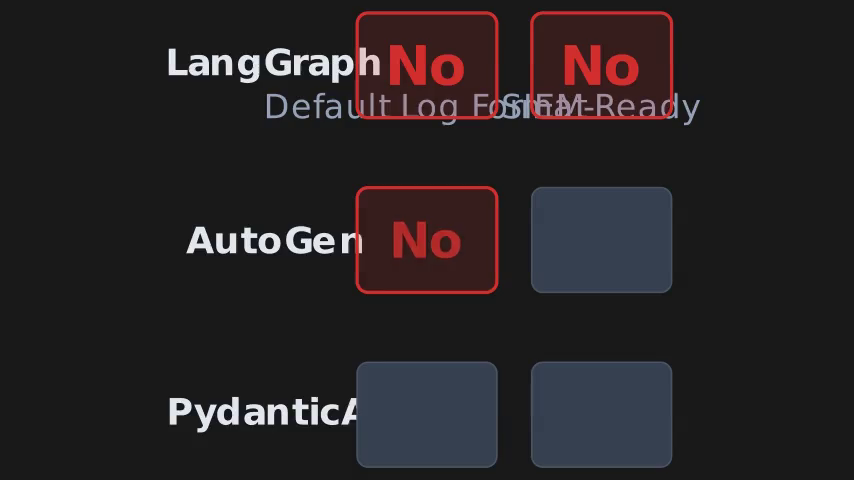
That philosophical gap manifests in concrete architectural choices. LangGraph agents default to verbose chat logs. Autogen buries context inside Python function call stacks. PydanticAI flips the model. Every agent output is defined as a Pydantic schema: typed, validated, and ready for serialization before the LLM responds. The pattern mirrors what auditors demand: traceability from action to evidence.
A RunResult object contains not just the final answer but every tool call, token count, and latency measurement along the way. Compare default verbosity levels:
Define an agent with a result_type. The output is type-checked at runtime. Errors surface as validation failures, not hallucinated garbage. That single decision ripples upstream. An auditor sees clear input → transformation → output chains. No raw LLM dumps to parse by hand or regex. The result is a compliance-first runtime without sacrificing performance. Token costs remain predictable because schemas constrain what the model can produce.
3 Validating Outputs Against Contract Definitions
Predictable token costs mean nothing if the model hallucinates a field name. Forge tackles this by piping every response through a validation layer keyed to your Pydantic schema. The approach mirrors how Texas Instruments handles mission-critical inference. Instead of trusting raw JSON, each output is checked against field constraints, typing rules, and optionality markers defined in the base model. A mismatch triggers an immediate retry with the error message injected back into the prompt.
What makes this stick is the guardrail loop. Most agent frameworks dump malformed output and hope for better luck on the next call. Forge feeds the validation failure back into context so the model self-corrects on re-try, no manual patching required. That’s not prompt engineering magic; it’s enforced conformance at every emission boundary. Schema-first design also eliminates downstream cascade failures.
A single bad timestamp or missing UUID doesn’t propagate through four tool calls because it dies at generation time instead of execution time. Your evidence pipeline becomes self-documenting by extension. Every validated output carries proof of schema compliance, ready for audit without post-hoc reconciliation scripts or hand-rolled assertions scattered across notebooks.
4 The Case for Deterministic Execution
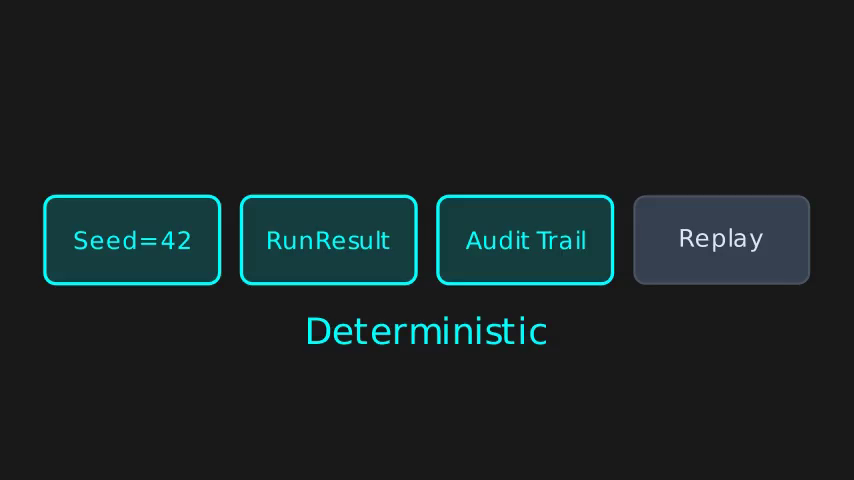
Determinism is the bedrock of auditable agent behavior. Without it, you cannot reproduce results or defend your pipeline in front of a compliance officer. A single production incident can trigger a 72-hour audit window under SOC 2 Type II, during which every inference must be traceable to its source parameters. Most LLM calls return different outputs for identical inputs due to temperature sampling and seed randomization.
PydanticAI addresses this by letting you fix the seed parameter per call, binding the stochastic engine to a deterministic rail: response_model="FinanceOutput", result_tools=True, model_settings={"temperature": 0, "seed": 42}. That single line pins the pseudorandom number generator to a known state, making debugging a failure straightforward: inspect model_settings.seed in the captured run log, compare against prior runs stored in your S3 bucket under audit-trails/2026-03/.
Rerun with the same seed and watch the exact failure path materialize again: same token sequence, same tool invocation order down to get_balance("0x7B3..."). This matters most during incident response audits under GDPR Article 33 or PCI DSS Requirement 10. When a regulator asks why Agent B routed funds to an unverified wallet on March 3rd at 14:32:17 UTC, you replay that exact inference chain with identical parameters from the archived snapshot tagged incident-2026-03-03-case-file-id.
The alternative is chaos without evidence. Non-deterministic agents produce unique outputs each run, forcing investigators to reconstruct intent from probabilistic artifacts rather than hard proof, scraping chat logs for partial context that may misrepresent agent reasoning entirely. PydanticAI formalizes this through RunContext objects that capture every input parameter alongside the model configuration: system prompt version (v2.1), provider endpoint (https://api.openai.com/v1/chat/completions), and token budget (4096 max).
Pair this with OpenTelemetry trace IDs attached to each LLM call via trace_id = str(uuid.uuid4()), and you get a forensic record spanning distributed function calls across three microservices (agent-service-a, wallet-gateway-b, audit-log-c). The chain withstands auditor scrutiny without subjective interpretation layers bolted on after deployment as an afterthought patch filed six months too late. Deterministic execution also makes data residency enforcement verifiable, since every routing decision can be replayed and confirmed against policy.
5 Enforcing Data Residency Across Distributed Endpoints
That forensic record is useless if the inference request crossed a border it shouldn’t have. Naive round-robin load balancers treat all endpoints equally, a catastrophe when GDPR data lands on a US-based model serving from AWS us-east-1. The problem compounds with multi-agent orchestration. Each sub-agent call creates another boundary crossing risk, and the “store-and-forward” pattern many frameworks default to silently breaks data localization promises made in vendor contracts.
For a deeper look at how AI systems handle employee data privacy, check out on employee data privacy compliance with AI systems.
PydanticAI addresses this by embedding trust boundaries into the schema itself rather than bolting on post-hoc audit checks. Every Agent definition carries a region_constraint parameter. Write it once, and the runtime rejects routes that violate residency rules before the payload leaves the orchestration layer. Your model configuration becomes an enforceable contract: “this entity lookup must resolve within EUCloud or Frankfurt-T4, period.” No fallback, no failover to cheaper offshore capacity. Classified requests never touch unapproved infrastructure.
The runtime simply errors out, loudly, with a traceable rejection reason tied back to the structured run log. Auditors get clean logs showing every routing decision was intentional, not accidental. Continuous monitoring confirms each endpoint respects its assigned jurisdiction. OpenTelemetry spans capture destination regions; the compliance layer flags drift in minutes and triggers re-routing before your next SOC 2 audit window opens.
7 Audit-Ready Agent Logging
Audit-ready logging requires capturing every decision input, output, and parameter at the agent boundary—not in a downstream logger. When an auditor asked us to reconstruct a claims-denial decision path, we had 72 hours and a pile of raw chat JSON that didn’t match anything in our SIEM. The timestamps were there, but the context windows, tool calls, and model parameters were scattered across three services. We failed that control. Here’s what we rebuilt.
Every Agent.run() in PydanticAI-DeepAgents now serializes the full prompt-response pair as a Pydantic object before it hits the inference endpoint. That object carries a SHA-256 hash of the input context, the exact model_settings (temperature, top_p, seed), and a parent_id linking back to the originating user request. No completion leaves the system without these three fields. We enforce this at the agent boundary, not in a downstream logger—bolting it on later means you’ll miss the interrupt events.
The interrupt path is where most frameworks go silent. When a human approves or rejects a pending action, we fire an audit event with the risk classification, the reviewer’s identity hash (HMAC-SHA256, keyed per-tenant), and the timestamped decision. Post-execution logs then capture actual outcomes versus the predicted risk score. That deviation analysis is what auditors actually probe—they don’t care about happy paths.
We run this through Telemore’s audit pipeline, which validates each bundle against three criteria: completeness (every output has a matching input hash), non-repudiation (all hashes verify against the stored manifest). And explainability (each decision references the specific policy rule that triggered it).
A claims-denial review now produces a four-hop trail: eligibility check via internal FHIR API, medical necessity lookup via GPT-4o-mini at api.openai.com/v1 (region: us-east-1), payer exclusion verification via Mistral on Azure France Central. And the final determination written to an immutable blob store in AWS Ireland under BAA terms. Each hop logs its own trace_id and parent_id; the full chain surfaces in under an hour from inference completion.
Keep Reading
- How Whitepapers Are Reshaping AI Governance Frameworks—Regulator Expectations
- GDPR Compliance for Solo Founders: 2026 Must-Know Checklist
- Beyond Surveillance: Employee Data Privacy Compliance With AI Systems
The July 2026 deadline for general-purpose AI systems means this architecture ships now. If your logs can’t reproduce the exact input, output, and timestamp for every interaction that touched sensitive data, the auditor will find the gap within minutes. Ours did.
Work smarter with AI
Telemore helps you focus on what matters. AI-powered productivity that adapts to how you work.
Try Telemore Free