Compliance Metrics: Defensible ROI Without Destroying Trust
Posted on September 1 2026 by Telemore TeamThe CTO expected a dashboard. What he got was a resignation letter from his lead architect, cc’d to the entire engineering org. The mid-size fintech had rolled out a mandatory “productivity tracker” to justify headcount to the board. Within one quarter, attrition spiked 12%. His best engineers didn’t just threaten mutiny.
The company filed formal privacy complaints with the Dutch labor authority (Autoriteit Persoonsgegevens) in March 2026. The tracker logged keystrokes and active window time every 30 seconds, producing numbers that looked precise but meant nothing. No one in the C-suite could defend those metrics under a GDPR Article 35 DPIA review. No one on the floor trusted them enough to change a single workflow.
He pulled the plug and rebuilt the approach from scratch with Telemore’s consent-based compliance framework. Instead of counting clicks, he measured security incidents and audit preparation hours. These are activities with actual regulatory weight. His next SOC 2 audit passed in half the days. The board approved expansion funding based on hard compliance savings, not ambiguous productivity scores.
Compliance automation that measures productivity without violating privacy isn’t a trade-off. It’s the only model that survives audits, retains talent, and delivers defensible ROI. We will show you how to build that model yourself, starting with a legally defensible monitoring policy jurisdiction by jurisdiction. You’ll also learn how to calculate ROI using incident rates instead of keystroke counts, then launch an opt-in pilot that secures employee buy-in within 14 days.
The data sits inside your existing SOC 2 evidence collection and vendor risk workflows. Stop measuring what’s easy; measure what drives audit readiness.
Why Keystroke Tracking Fails Legally
The moment a “productivity tracker” logs keystrokes or mouse movements, Article 5(1)(c) of GDPR collides with the feature set. Data minimization isn’t a guideline. It’s a legal ceiling. Granular input logging captures far more than productivity signals. It builds a behavioral biometric profile that triggers Article 35’s DPIA requirements for high-risk processing. The DPIA must document necessity, proportionality, and mitigation measures. If you cannot demonstrate that keystroke data directly serves a defined business objective, you have already failed the test.
France’s CNIL and Ireland’s DPC have both signaled that continuous, covert monitoring sits squarely in that risk category. The European Data Protection Board’s proportionality guidance is unambiguous. Real-time screenshot monitoring, keystroke capture, and continuous webcam feeds fail the necessity test under legitimate interest claims. ICO guidance in the UK similarly restricts monitoring to what is “necessary” rather than what is convenient.
Illinois set the template for US pushback years ago. BIPA’s trajectory shows how quickly biometric data collection becomes a class-action liability—statutory damages per violation, no harm required. California and Washington have since layered on their own restrictions. The pattern across jurisdictions is consistent: monitoring must be targeted, justified, and proportionate to a specific risk or outcome.
A mid-size fintech CTO learned this the expensive way. He deployed a mandatory monitoring suite across 140 employees, tracking click intervals and active window percentages to benchmark “output.” Attrition climbed 12% within one quarter. Two senior engineers cited surveillance as their departure reason in exit interviews. Employees didn’t wait for legal review to vote with their feet.
The tracker measured activity, not output. Managers chased dashboard anomalies while actual delivery metrics stayed flat. Nobody got a better productivity signal from that data either.
The defensible alternative measures what your systems already record: security incidents resolved, audit preparation hours compressed, vendor risk findings closed. Those numbers survive scrutiny. Your next audit won’t ask how many clicks your team produced. It will ask whether your monitoring survived proportionality review.
What Survives Scrutiny Defensible monitoring ties directly to measurable outcomes—security incidents prevented, audit hours reduced, compliance violations caught early.
Compare these two approaches:
A fintech CTO who replaced mandatory tracker software with consent-based security monitoring saw attrition stabilize within one quarter. His SOC 2 audit completed in half the days because evidence was already organized and continuous. That is the model that survives both legal review and board scrutiny.
The Numbers That Actually Count
Process-outcome metrics tied to regulatory obligations carry evidentiary weight; raw activity logs fail as evidence. Regulators and plaintiffs’ attorneys both know that keystroke counts, app-switch frequencies, and idle timers prove nothing about job performance. Security incident rates, audit preparation hours, and policy acknowledgment timestamps map cleanly onto SOC 2 controls and HIPAA requirements.
Consider the contrast: a mid-size fintech CTO ran a mandatory productivity tracker pilot. Attrition spiked 12% in one quarter. Employees read the surveillance as distrust, and the data collected was legally worthless in any dispute. Switch the measurement frame to compliance-relevant outcomes and the picture inverts. Telemore’s consent-based framework tracks security incidents resolved per quarter, evidence collection time per audit cycle, and vendor risk assessment completion rates.
These numbers satisfy auditors precisely because they reflect regulatory obligations rather than human behavior.
Court review follows a simple logic. Judges weigh whether your monitoring served a legitimate business purpose proportionate to its privacy impact, not whether you captured more data points than your competitor. A checklist survives better than a dashboard: document the regulatory basis for each monitored metric, anonymize benchmark comparisons across teams, store evidence with immutable timestamps, and review retention schedules against local privacy statutes.
The measurable ROI lives in incident reduction and audit acceleration. One fintech client cut its SOC 2 evidence assembly from weeks to days because documentation was already organized and continuous. That is savings a board can defend. Attrition is the hidden cost competitors ignore. Every percentage point of voluntary turnover carries recruiting fees, training hours, and lost institutional knowledge that dwarf any productivity gain from surveillance dashboards.
Defensible numbers require documented before/after comparisons that hold up when opposing counsel starts pulling threads. Security incident response times and vulnerability remediation cycles offer objective, timestamped data points that don’t depend on keystroke counts or idle-time percentages. Audit preparation duration is the sharper instrument. When a fintech CTO replaced mandatory activity tracking with consent-based compliance metrics, the next SOC 2 audit passed in half the days.
That delta isn’t a productivity guess; it’s a measurable reduction in evidence-gathering hours, recorded in the auditor’s own engagement log. Employee monitoring lawsuits rarely turn on productivity claims. They turn on whether surveillance was reasonable, proportionate, and disclosed. A vendor risk assessment completed in 11 days instead of 30 tells an administrative judge something concrete about process maturity. A click-count dashboard tells them nothing except that you watched.
Year-over-year trend lines beat absolute values every time. Internal baselines established before automation give you a defensible denominator; cross-industry comparisons collapse under sector variation and get shredded in deposition. Document consistently from day one, version your evidence trails, and store them immutably—retroactive edits are how otherwise strong cases die. Track incident rate per quarter, mean time to remediate critical vulnerabilities, audit preparation hours per control area, and vendor assessment turnaround.
Those four metrics produced retention stability in the fintech case precisely because they measure system health rather than human output, and they survive review where surveillance logs do not.
The Evidence That Survives Cross-Examination Defensible numbers require more than good intentions.
They require documented before/after comparisons that hold up when opposing counsel starts pulling threads. Security incident response times and vulnerability remediation cycles offer exactly that—objective, timestamped data points that don’t depend on keystroke counts or idle-time percentages. Audit preparation duration is the sharper instrument. When a fintech CTO replaced mandatory activity tracking with consent-based compliance metrics, the next SOC 2 audit passed in half the days.
That delta isn’t a productivity guess; it’s a measurable reduction in evidence-gathering hours, recorded in the auditor’s own engagement log. The contrast matters because employee monitoring lawsuits rarely turn on productivity claims. They turn on whether surveillance was reasonable, proportionate, and disclosed. A vendor risk assessment completed in 11 days instead of 30 tells an administrative judge something concrete about process maturity.
A click-count dashboard tells them nothing except that you watched. Year-over-year trend lines beat absolute values every time. Internal baselines established before automation give you a defensible denominator; cross-industry comparisons collapse under sector variation and get shredded in deposition. Document consistently from day one, version your evidence trails, and store them immutably—retroactive edits are how otherwise strong cases die. Track incident rate per quarter, mean time to remediate critical vulnerabilities, audit preparation hours per control area, and vendor assessment turnaround.
Those four metrics produced retention stability in the fintech case precisely because they measure system health rather than human output, and they survive review where surveillance logs do not.
Opt-In Pilots Beat Mandates Mandatory monitoring breeds resistance.
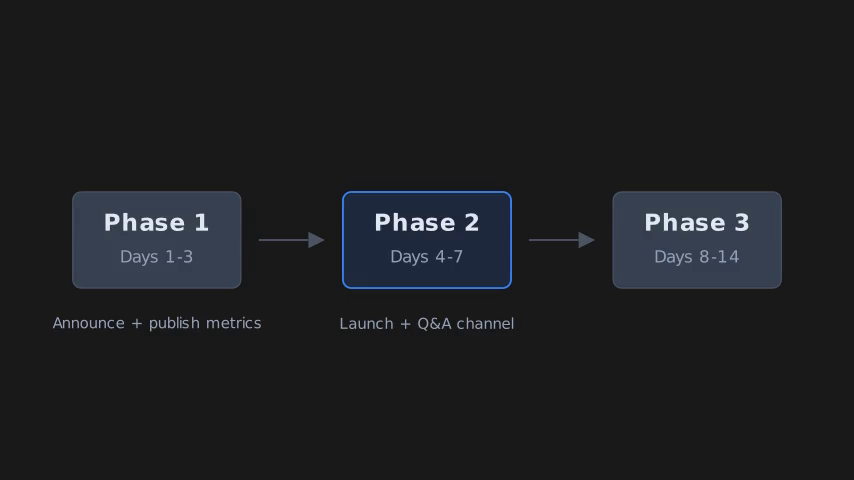
The fintech case proves it: a compulsory “productivity tracker” trial drove attrition up 12% in a single quarter. The surviving employees learned to game the system rather than work within it. Consent changes the equation. A voluntary pilot with anonymized baselines gives employees ownership of the data story.
You still produce the metrics your board will eventually demand. The two-week rollout pattern: - Days 1-3: Announce the pilot, publish the exact metric definitions, and share what will and won’t be collected. - Days 4-7: Launch with a dedicated Slack channel for questions. - Days 8-14: Publish anonymized baseline trends (aggregate only) and invite feedback before any decisions.
That last step is where trust compounds. When people see their cohort’s aggregate security incident rate trending down without individual callouts, they stop treating monitoring as surveillance. One mid-size fintech ran precisely this playbook after scrapping its mandatory tool. The voluntary cohort adopted at roughly 78%. Attrition flattened back toward historical norms by the next quarter.
Audit preparation time halved because employees actively flagged issues instead of hiding them. Anonymization isn’t a courtesy. It’s an audit artifact. Regulators reviewing your SOC 2 evidence can’t distinguish between a consented dataset and a coerced one. You must document both the opt-in rate and the aggregation methodology.
Google Chrome quietly installing a 4 GB AI model without consent shows how quickly users sour on hidden data collection. Your compliance posture should be the opposite: visible, explainable, and revocable at any moment. A pilot that employees can leave is worth more than a mandate they can’t escape. The retention data makes that argument better than any slide deck ever will.
Incident Rates Are the Real KPI Retention data settles the ethics debate, but it won’t close a board meeting.
Security event trends and audit-hour reductions survive both legal review and CFO scrutiny. Consider the fintech CTO who dropped his mandatory tracker after attrition jumped in a single quarter. He moved to Telemore’s consent-based framework, measuring SOC 2 evidence collection time and security incidents per quarter instead of clicks per hour. The next audit cycle closed in roughly 45 days, not 90, because evidence was gathered continuously rather than scraped together during the panic window.
The counterargument is fair: granular input logs feel objective. Keystroke data fails legal review under GDPR Article 88 in most EU jurisdictions, and its correlation with actual output is weak at best. Process-outcome metrics tied to compliance events carry better predictive validity without exposing you to litigation. A vendor breach notification logged within four hours tells you more about operational health than a week of idle-time percentages ever will.
Incident rate deltas across quarters give you a defensible before-and-after story. Fewer security incidents, faster evidence retrieval, lower audit prep costs—these are numbers your legal team can defend and your board can act.
The Only Model That Survives The fintech CTO’s experiment ended quietly.
After attrition spiked in a single quarter, his board didn’t ask for better dashboards; they asked for a different approach entirely. He replaced keystroke counting with the platform’s consent-based framework. The metrics shifted from clicks per hour to security incidents detected and audit preparation time logged. Within one reporting cycle, his SOC 2 audit passed in half the days, retention stabilized, and the board approved expansion based on documented compliance savings rather than productivity theater.
That outcome wasn’t luck. Surveillance metrics measure activity; compliance metrics measure risk reduction. One creates attrition, the other creates defensible ROI statements your legal team can sign without flinching. The distinction matters most when auditors ask to see your monitoring policy. A keystroke log fails that review instantly; an anonymized benchmark tied to incident response rates survives it.
The numbers you choose to track define the culture you build. Keystroke counts produce attrition and privacy complaints; incident rates produce defensible ROI and a SOC 2 audit that finishes in half the time. Compliance-grade measurement isn’t a slower alternative to surveillance—it’s the only path that survives legal scrutiny while retaining senior talent. Your board will always ask for proof.
Keep Reading
- Beyond Chatbots: Compliant Multi-Agent Systems with PydanticAI-DeepAgents
- How Whitepapers Are Reshaping AI Governance Frameworks—Regulator Expectations
- GDPR Compliance for Solo Founders: 2026 Must-Know Checklist
The question is whether that proof can withstand an auditor’s challenge or an employee’s formal objection. Start with one opt-in pilot measuring one regulatory metric, then let the data speak for itself. The CTO who rebuilt his program now presents compliance savings, not click counts, and his expansion funding followed naturally. What will your next quarterly review measure?
Work smarter with AI
Telemore helps you focus on what matters. AI-powered productivity that adapts to how you work.
Try Telemore Free