Beyond Surveillance: Turn Screen Time into Audit-Ready Expertise
Posted on November 4 2026 by Telemore TeamThe Surveillance Trap Every Vendor Ignores
Maya closed the laptop and felt the loss physically. As Head of Compliance at a 140-person Berlin fintech, she’d just watched her top seller walk out. Six months of undocumented negotiation tactics went with them. The client objections, pricing hesitations, and competitive pressure points that won deals were all sitting in Slack huddles. Her legacy tracker logged every keystroke and hour but captured zero intelligence.
The audit trail was pristine; the knowledge vault was empty. That’s the trap of traditional employee monitoring. It measures activity while ignoring output value. Telemore calls this the difference between surveillance and stewardship. It’s why compliance-first platforms are about to eclipse their productivity-obsessed predecessors.
The future belongs not to surveillance leaders but to compliance-first platforms that turn screen time into searchable expertise. Telemore makes trust the product. When Maya’s team switched to a Knowledge Vault approach, those Slack huddles became indexed assets rather than ephemeral chatter. Germany’s strict GDPR compliance for solo founders rules stopped being a compliance hurdle. They started being a competitive advantage.
Your current tool tracks hours. It doesn’t capture insight. And when your best people leave, they take both with them. You’ll see how to close that gap: auditing your monitoring stack against GDPR, HIPAA, and SOC 2 obligations using a three-tier data classification framework. Plus drafting a transparent policy script that discloses what’s tracked, why it matters, and how employees access their own vaulted contributions.
You’ll finish with a compliance posture that turns employee monitoring from an HR liability into an organizational asset.
That three-tier framework sounds tidy. The messy reality arrives before you ever classify a single record. Maya, Head of Compliance at a 140-person fintech in Berlin, discovered this the hard way. Her sales team’s Slack huddles held client objections no one had documented. They also captured pricing pushback patterns, competitor comparisons, and negotiation red lines.
Her legacy tracker logged hours with precision but captured zero insight. When her top seller resigned in March, six months of tactical knowledge vanished without a trace. Legacy trackers count keystrokes and screenshots but never answer the harder question: what happens to that data after Tuesday’s shift ends?
Fragmented digital evidence derails internal investigations. These are the very cases where monitoring should protect the organization. Germany’s Works Council rules sharpen the stakes further. Covert surveillance triggers statutory consequences that make California’s CCPA look lenient by comparison; works councils can block monitoring deployments entirely when employee consent lacks specificity or purpose limitation.
Auditors don’t buy dashboards; they buy retention policies. That real-time activity stream looks great until a SOC 2 examiner asks why you’re holding 36 months of screenshots for roles that require none. The legal exposure sits in your log files, not the UI. Maya’s failure wasn’t under-collection. It was untethered data with no deletion schedule.
She had monitored activity disconnected from any knowledge structure, captured without a purpose-bound strategy for retention or retrieval. Her compliance obligations under GDPR Article 5 required purpose limitation; her vendor’s architecture ignored it entirely. Every section heading in their marketing promised “visibility.” None mentioned defensibility under audit scrutiny.
The Cost of Observation Without Memory
Audits don’t reward watching. The distinction between capturing motion and preserving meaning is not academic. Maya’s tracker logged activity, but when a Works Council member in Frankfurt asked for a list of data categories processed under Article 30 of GDPR, she produced a spreadsheet of timestamps. The council’s response took four days to arrive, and it cited §26 BDSG with the precision of a scalpel: covert observation without explicit consent is presumptively unlawful.
Her vendor’s terms of service did not matter. The same fracture appears across enterprise deployments: fragmented digital evidence derails internal probes, not because footage is missing, but because no one can stitch raw logs into a coherent timeline.
A screen-time graph showing six hours in Outlook does not answer whether an employee forwarded proprietary pricing files to a personal Gmail account at 2:47 PM on October 12th. The raw events exist; the narrative does not. Three-tier classification exposes what most dashboards bury. Tier 1 covers time tracking and attendance; retention obligations run two to three years depending on jurisdiction. Tier 2 includes application usage and URL visits; GDPR Article 5(1)(e) demands deletion once the purpose is fulfilled.
Tier 3 captures content: emails, Slack huddles, documents.
That tier requires an independent legal basis plus explicit employee access rights before indefinite retention becomes defensible. Most monitoring platforms collapse all three into one bucket labeled “activity logs.” That single container satisfies neither data minimality nor storage limitation, and it gives a works council exactly the ammunition it needs to demand deletion orders.
The operational cost mirrors the legal one with brutal symmetry. When Maya’s top seller resigned after four years on the desk, his client objection handling scripts vanished with his Slack history export, which IT overwrote eleven days later per their standard retention schedule. No indexing existed because her platform never distinguished between watching an employee and capturing their expertise for reuse.
Evidence decays fast when observation lacks memory architecture. Compliance demands both halves: the record and the recall infrastructure to query it later at speed. Without that second piece, you own data you cannot use and surveillance you cannot justify—a combination that fails every auditor who asks why you kept something in the first place.
A knowledge vault changes this calculation by tagging content at capture time with semantic metadata. Entity names extracted from email threads via spaCy or Microsoft Presidio running inside your own VPC rather than on a vendor’s cloud cluster keep downstream costs out accordingly.
The Retrieval Gap Nobody Audits
The record without recall is just liability. Compliance frameworks from GDPR to SOC 2 demand you produce, explain, and delete evidence on command. Yet most monitoring stacks store activity as orphaned telemetry with no contextual index tying it to decisions, objections, or outcomes. Consider the German Works Council posture: covert surveillance triggers co-determination rights under BetrVG §87. A Berlin fintech like Maya’s cannot silently log Slack huddles and call it compliance; consent must be explicit, purpose-bound, and revocable.
Telemore’s Knowledge Vault answers that objection by making the monitored artifact useful. The same keystrokes that document hours also surface as searchable client objections, negotiation tactics, and product feedback. The contrast is stark. Legacy trackers give you a timesheet; Telemore gives you a corpus. When Maya’s top seller resigns, her successor doesn’t inherit a blank page. She searches the vault for “pricing pushback” and finds six months of recorded rebuttals indexed alongside screen-time data.
Here is the operational difference: deletion protocols fail when organizations cannot distinguish raw logs from synthesized knowledge. Article 17 erasure requests become existential if every Slack huddle is irreplaceable institutional memory. Classify data into three tiers—transient activity (delete on request), contextual records (anonymize), and vaulted expertise (retain with legal basis)—and GDPR compliance stops being a fire drill. Maya’s problem was never surveillance volume; it was retrieval precision.
She had terabytes of proof that people worked and zero capacity to prove what they knew.
Retrieval Trumps Surveillance
Maya’s monitoring stack measured hours, not insight. Every German fintech competitor faces the same structural gap: screen time is captured, then discarded. The economics are brutal. Workers lose time hunting for information that already exists inside their own company. Multiply that lost time across 140 employees and you’re funding a permanent scavenger hunt. A knowledge vault inverts the model.
Instead of recording that someone worked, it preserves what they produced. Every Slack huddle, every Zoom transcript, every ad-hoc doc becomes searchable evidence of expertise. Three-tier classification makes this audit-ready. Tier one covers public knowledge like onboarding materials; tier two captures team-specific workflows; tier three holds sensitive client negotiations governed by GDPR. Each tier demands different retention windows and access controls.
Legacy trackers fail this test outright. They log keystrokes and app switches but cannot reconstruct a sales objection raised in a Tuesday huddle or trace how a pricing concession was negotiated in June. The real damage of replacing a top performer isn’t just cost-per-hire; it’s forfeiting months of undocumented negotiation tactics and client relationships stored nowhere searchable.
GDPR penalties add regulatory teeth to the retention problem. European regulators have fined companies under Art. 32 precisely because they could not produce processing records linking employee actions to stored data. The vault solves both retrieval and compliance simultaneously. Audit your current tool against these three tiers today. If it cannot classify what it captures or retrieve what it stores, you are paying for surveillance while losing expertise.
The Knowledge Vault Test
That classification exercise exposes a deeper problem. Most monitoring tools store activity as flat logs. Timestamps, URLs, and application names sit stripped of the context that makes information useful. Context is the difference between raw data and institutional knowledge. A Slack huddle transcript containing a client’s objection about pricing tiers carries more value than the log line “huddle_duration: 42 minutes.” Yet most vendors only capture the latter because it requires less engineering effort.
GDPR Article 32 sharpens the stakes. German regulators expect demonstrable processing records tied to employee actions. Fintech firms under BaFin supervision face audit trails measured in months, not years. An unlogged decision trail reads as non-compliance by default. Run what the platform calls the retrieval test.
Pull ten recorded sessions from last quarter and ask whether a new hire could reconstruct the reasoning behind a critical deal or a compliance decision from those artifacts alone. If the answer is no, your monitoring investment produces storage costs without generating searchable expertise. The fix is architectural, not cosmetic. Indexed conversation content must sit beside monitored activity in a single vault with access controls that satisfy both privacy obligations and audit requirements.
That synthesis transforms screen time from surveillance liability into procedural memory. It marks the difference between losing six months of negotiation tactics when a top seller departs and onboarding their replacement with their full playbook intact.
The Architecture of Retrievable Expertise
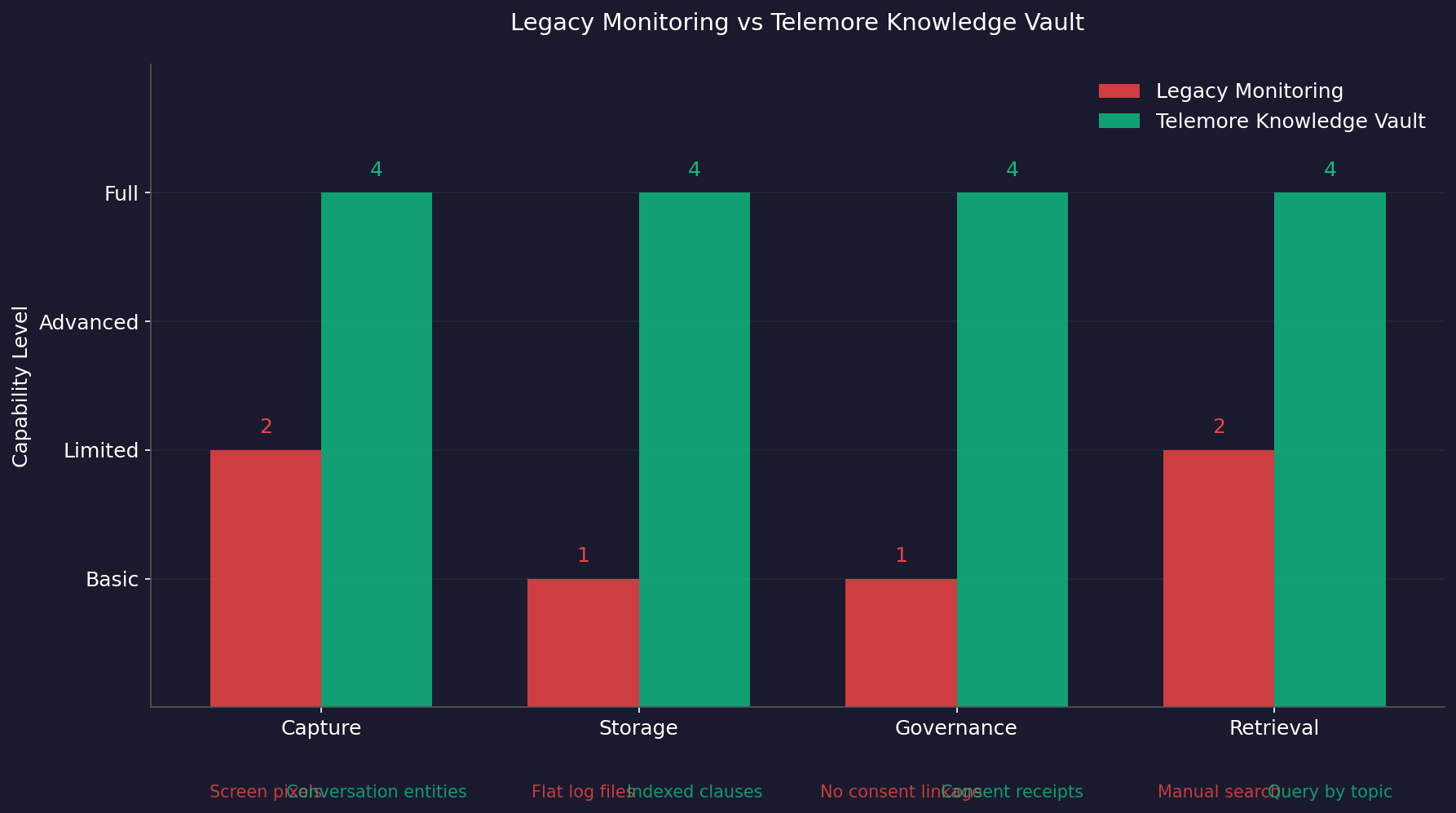
Raw storage and governed memory are different engineering problems. A dashboard that shows hours logged is a database query. A Knowledge Vault is an indexing pipeline with provenance attached to every token. The compliance tool’s entity extraction runs continuously across monitored feeds, not as a batch job at month-end. When your sales team surfaces a client objection in Slack at 14:32, the system tags that phrase and binds it to the conversation thread.
It links the phrase to the consent receipt signed by each participant, then writes the composite record into an immutable audit trail. That trail answers three questions simultaneously. It records what was said, when it was said, and who legally permitted the capture.
The retrieval layer matters more than the capture layer. SOC 2 auditors do not want to see your raw logs. They want evidence that specific controls operated over specific data at specific times. A vault with entity-level indexing produces that evidence on demand. No forensic reconstruction required. Maya’s six months of negotiation tactics would have been invisible to her legacy tracker.
Each huddle contained objections like “your uptime SLA is too thin for our German hosting requirements.” That critical intelligence was stored nowhere. Entity extraction converts that sentence into a searchable clause tagged client_objection, linked to the GDPR consent receipt signed by every huddle participant, and retrievable during her next deal review. The departing seller takes their laptop; the institutional memory stays behind.
Consent That Survives Both Sides
The counterargument deserves a fair hearing. Monitoring tools have burned trust. Webcam captures, keystroke logs, and termination metrics all played a part. Those failures weren’t compliance oversights; they were consent failures baked into the architecture. But the equation flips when you price the alternative. Maya’s six months of lost negotiation tactics carry a concrete dollar figure, one that SOC 2 audits and vendor risk frameworks can’t fully hedge.
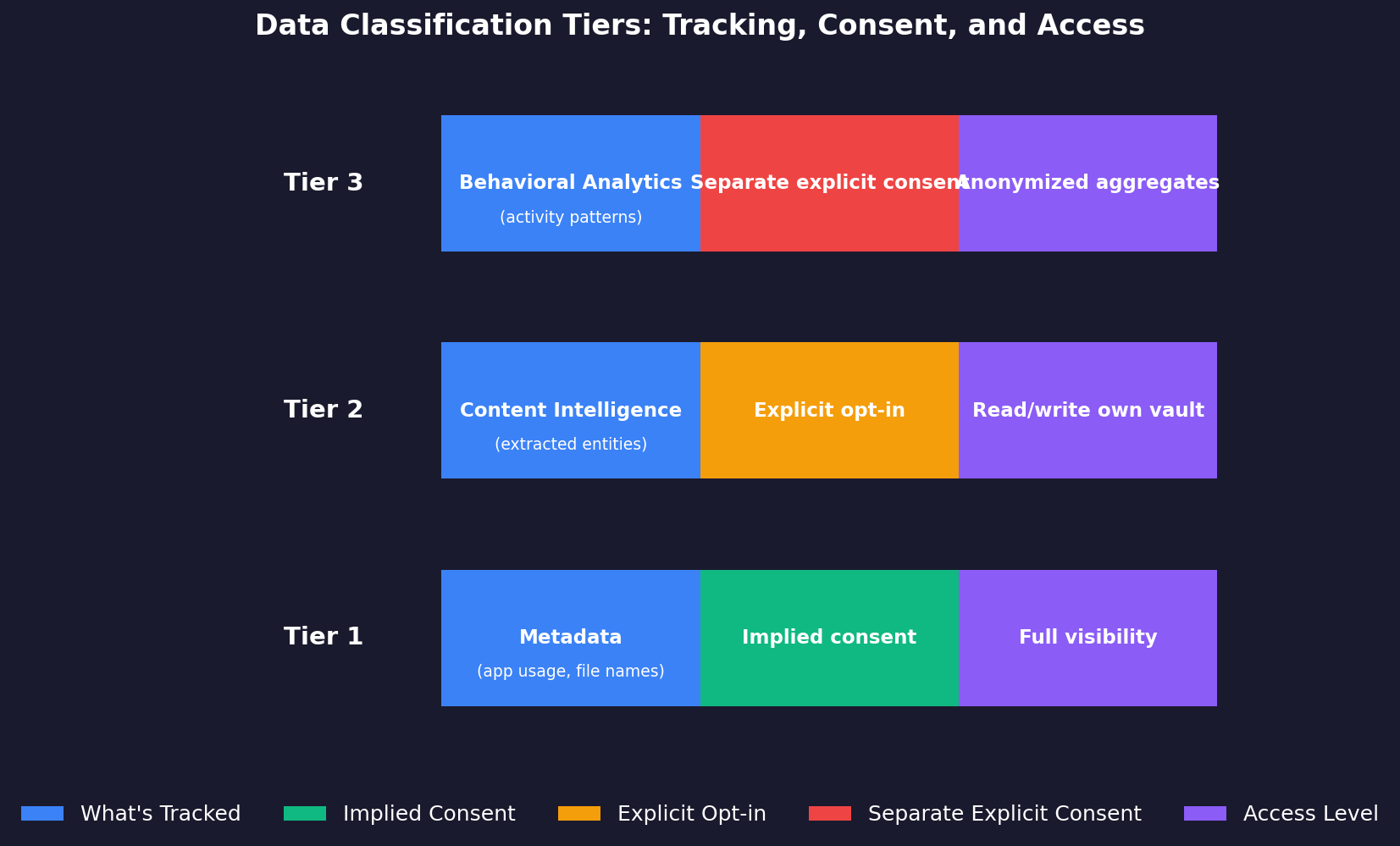
That number dwarfs the cost of any SOC 2-aligned monitoring deployment. Unmonitored knowledge evaporation is a financial event disguised as a personnel change. The consent mechanism that resolves this tension is granular, not blanket. Germany’s GDPR demands explicit opt-in for each data category. The platform structures collection in three tiers: work-product metadata (app names, document titles), content intelligence (extracted entities from Slack huddles and emails), and behavioral analytics (activity patterns).
Each tier carries its own consent receipt, revocable independently.
The policy script matters as much as the technology. A defensible disclosure names every system monitored and states the business purpose in plain language (“preserve client negotiation context”). It also grants employees read access to their own vaulted knowledge, not just an appeal path.
That last clause transforms the dynamic. When employees see their own expertise archived and searchable, monitoring shifts from surveillance to authorship. Their consent becomes informed because they receive measurable value from participation. Trust isn’t eroded by observation; it’s eroded by opaque extraction. The compliance tool’s architecture makes the exchange legible: your work yields institutional memory you can query anytime you need it. That transparency turns compliance from a legal hurdle into a retention strategy.
It survives both courtroom scrutiny and Monday morning all-hands meetings.
Trust Becomes the Product
Maya’s story ended quietly. No dramatic resignation, no data-loss crisis. Just a Tuesday morning where her top seller gave notice and she handed him a query prompt instead of a goodbye questionnaire. His six months of client objections surfaced in seconds, indexed by Telemore’s Knowledge Vault alongside the compliance logs that satisfied Germany’s BaFin expectations. The fintech kept the institutional memory; he kept his references.
That outcome is the thesis in miniature. Screen time becomes searchable expertise, but only when employees trust the vault as their asset rather than their judge. Privacy guardrails made that possible. GDPR consent baked into onboarding, no keystroke capture beyond work hours, employee access to every indexed artifact via a self-serve dashboard. Surveillance leaders built dashboards for managers.
Compliance-first platforms build archives for everyone. The shift mirrors what package tracking did for logistics two decades ago: UPS and FedEx turned opaque movement into customer-visible data, transforming anxiety into confidence. Employee monitoring is undergoing the same inversion. When workers can query their own knowledge trail, oversight stops feeling like suspicion and starts reading as infrastructure—the firm’s most defensible asset under SOC 2 auditor scrutiny or HIPAA investigation.
Does your current tool classify data by sensitivity tier before collection? Can employees retrieve what you record about them without filing an internal request? Does your policy document name every system that touches monitored activity, say, the endpoints tracked in your SOC 2 evidence log? A no on any of those puts you at regulatory risk, even if your dashboard shows 99.9% uptime.
Every audit trail you build either preserves expertise or buries it. The choice is not between privacy and oversight; it is between stewardship and waste. Your next hiring round, your next SOC 2 renewal, your next GDPR inquiry will all test that decision. If screen time becomes searchable knowledge, then turnover stops being a leak and starts being a transfer of institutional memory. That is the only version of monitoring that compounds.
Keep Reading
- Beyond Chatbots: Compliant Multi-Agent Systems with PydanticAI-DeepAgents
- How Whitepapers Are Reshaping AI Governance Frameworks—Regulator Expectations
- GDPR Compliance for Solo Founders: 2026 Must-Know Checklist
What will your compliance team search for when your top performer leaves?
Work smarter with AI
Telemore helps you focus on what matters. AI-powered productivity that adapts to how you work.
Try Telemore Free